The Olmo 3 model family
Pick a variant to explore weights, code and reports. Every card includes instant links to artifacts.
Read the technical report
32B-Base
Achieves strong results in programming, reading comprehension, and math problem solving, maintains performance at extended context lengths, and works well with RL setups.
32B-Think
Capable of reasoning through complex problems step by step. A strong platform for RL research and other advanced experiments that need serious horsepower.
32B-Instruct
Our most capable fully open chat model to date. An instruction-tuned model built for chat, tool use, and multi-turn dialogue.
7B-Base
A smaller, lighter-weight base model able to run on a wider range of hardware while delivering competitive performance.
7B-Think
Delivers strong reasoning capabilities at 7B scale, surfacing intermediate thinking steps for complex prompts at high efficiency.
A complete model flow
To truly advance open AI development and research, the entire model flow – not just its endpoint – should be accessible and customizable. The model flow is the full lifecycle of an LM, starting with the data.
Explore the Model Flow
Click on any stage to learn more about it and download artifacts.


The fully open mixture used to train Olmo from scratch—curated web, code, books, and scientific text—deduplicated and quality-filtered.
Targeted continuation sets used to refine the base model mid-course. Higher-quality, domain-focused mixtures.
Corpora used after pretraining for instruction tuning and preference-based optimization where applicable—supervised responses and comparison data.
Open-source tools
These are the tools we use to make Olmo.
Data preprocessing tools
- Duplodocus
Ultra-efficient fuzzy de-duplication
- Datamap-rs
For large-scale data cleaning


What people are saying
Built for research— already making impact
From unlearning to clinical NLP, Olmo is powering discoveries across domains. Explore how researchers are using fully-open models.


Machine unlearning with Olmo-7B
Researchers used Olmo-7B as a testbed for developing machine unlearning methods—removing specific data influence without retraining from scratch.

Clinical NLP applications
Healthcare teams leveraged Olmo checkpoints to explore clinical text analysis while preserving transparency around data and methods.

Understanding how LLMs learn
Olmo’s openness—datasets, logs, and checkpoints—enabled fundamental studies into learning dynamics and scaling behaviors.
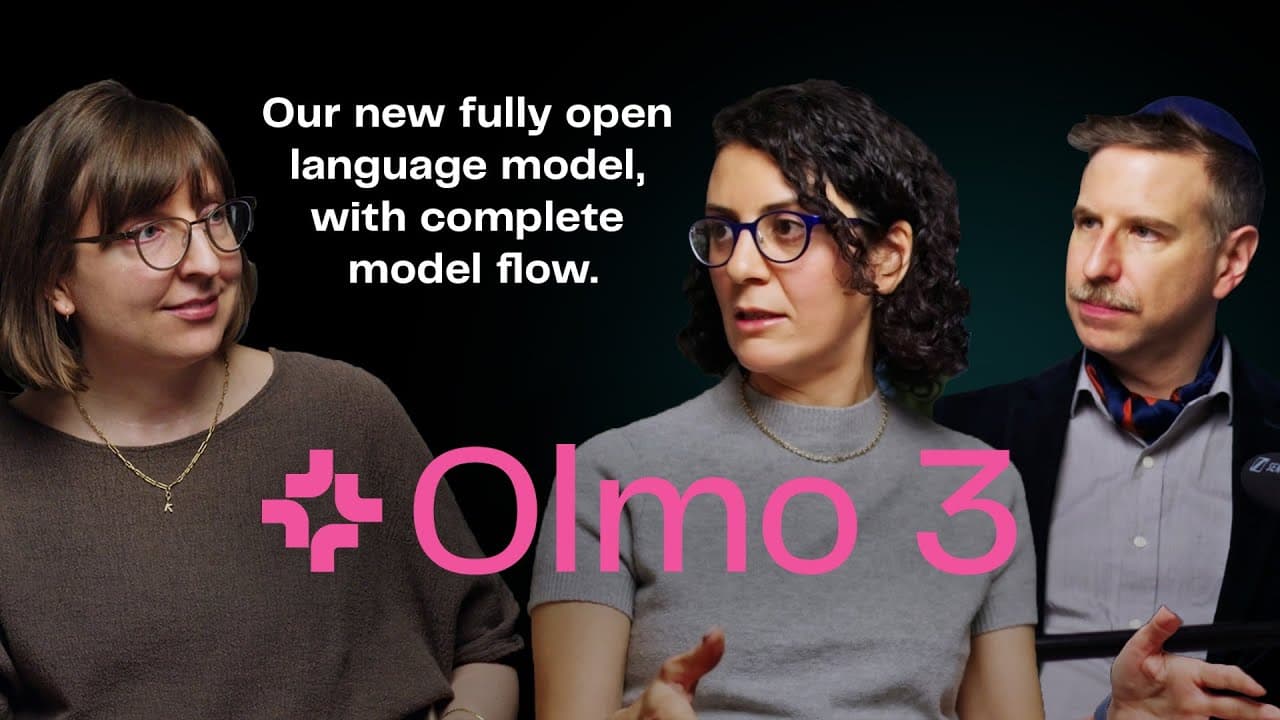
Deep dive with Olmo lead researchers Hanna Hajishirzi and Noah Smith on how - and why - we built Olmo 3, and what comes next.