Ai2 and Providence Swedish Cancer Institute partner to advance AI-assisted scientific discovery
The collaboration includes clinically meaningful research findings on lobular breast cancer, and a local deployment to enable next-gen discovery while keeping clinical data secure.
August 27, 2026
Ai2
Today, Ai2 announced a new partnership with the Paul G. Allen Research Center (PARC) at Providence Swedish Cancer Institute to apply Ai2’s AI-powered scientific discovery platform, AutoDiscovery, across cancer research datasets.
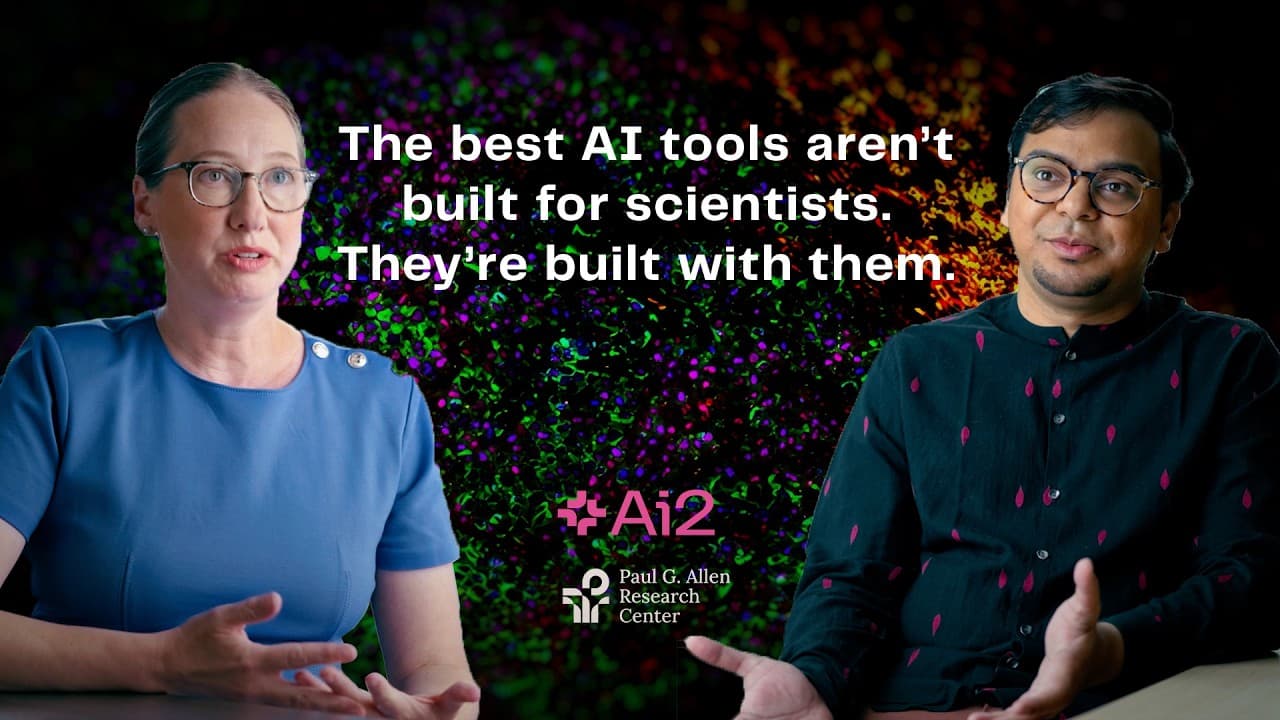
This partnership represents an important milestone for AutoDiscovery as it moves beyond public research datasets into active cancer research programs at a leading oncology research center. It’s a particularly significant deployment given the high standard required for AI adoption in biomedical science, where every finding must be transparent, reproducible, and independently validated before informing future research.
The decision to expand the collaboration builds on a new research paper authored by a joint team led by Providence researchers, Dr. Kelly Paulson of the Paul G. Allen Research Center and Dr. Sasha Stanton of the Earle A. Chiles Research Institute, and Ai2’s Senior Research Scientist Bodhisattwa Majumder. Working together, the team used AutoDiscovery to analyze one of the world's most extensively studied breast cancer datasets, uncovering a stronger immune signature in invasive lobular breast cancer than previously recognized. Subsequently, this finding was validated across an independent patient dataset and through laboratory analysis.
The findings suggest that it may be possible for an entire class of breast cancer patients to benefit from immunotherapy, representing roughly 15% of breast cancers diagnosed in the US each year. The results also illustrate how AI-assisted hypothesis generation can help researchers uncover questions worthy of further investigation.
Helping researchers navigate an era of scientific abundance
Biomedical research has entered an era of unprecedented data generation. Public repositories now contain decades of genomic, molecular, clinical, and imaging data representing millions of patients, and protected datasets within cancer centers and research institutes represent a potential trove of new insights. While these resources have transformed medicine, they have also created a new challenge: the scale and complexity of modern datasets make it increasingly difficult to comprehensively explore the scientific questions they contain.
Scientific research has traditionally been driven by hypothesis testing. Researchers develop a question, design an experiment, and evaluate the results. AutoDiscovery introduces a complementary approach to exploring complex datasets by generating and evaluating surprising hypotheses with large language models, which researchers can then investigate through established scientific methods. Rather than evaluating all possible directions equally, it prioritizes observations that are both surprising relative to prior expectations and reproducible across analyses, allowing iterative interrogation of the most informative signals.
Rather than operating independently, AutoDiscovery was designed to work alongside scientists, allowing researchers to guide it in promising directions, apply domain expertise, and determine which findings warrant further investigation. The collaboration between Ai2 and PARC demonstrated that this partnership between AI and researchers produced stronger results than either could achieve alone.
“AutoDiscovery wasn't built to replace scientific expertise. It was built to amplify it,” said Bodhisattwa Majumder, Senior Research Scientist, Ai2. “The most meaningful discoveries come from enhancing AI's ability to systematically explore complex datasets with the experience and intuition of scientists who know how to interpret, validate, and build on those findings. Our collaboration with the Paul G. Allen Research Center demonstrates what that model can achieve.”
New research demonstrates the potential of AI-assisted discovery
As part of the collaboration, researchers applied AutoDiscovery to The Cancer Genome Atlas (TCGA), one of the most comprehensive cancer datasets ever assembled.
Among AutoDiscovery's findings was an unexpected observation: invasive lobular carcinoma (ILC), a subtype of breast cancer historically considered “immune cold,” or unresponsive to immunotherapy, appeared to exhibit a stronger immune signature than previously recognized.
Researchers validated the finding across an independent breast cancer dataset before confirming the observation through laboratory analysis of tumor samples. Together, the results – which were published today in the paper “Surprisal-based large language models reveal immunologic insights in breast cancer” – suggest that this subtype of breast cancer may warrant broader investigation in future immunotherapy research.
“Cancer researchers have access to extraordinary datasets, but the challenge is no longer collecting data; it's understanding everything those datasets have to tell us,” said Dr. Kelly Paulson, MD, PhD, Lead for the Center for Immuno-Oncology, Paul G. Allen Research Center. “AutoDiscovery helped us identify a promising signal that we may not have otherwise investigated, and from there we were able to validate the finding through additional datasets and laboratory research. That's an exciting step forward for cancer discovery.”
The collaboration with the research center represents an important step in Ai2's broader vision for AI-assisted scientific discovery.
“Having the Paul G. Allen Research Center deploy AutoDiscovery on its own research datasets is an important milestone for us,” said Peter Clark, interim CEO, Ai2. “Scientific discovery depends on trust, and trust is earned through close collaboration with researchers and rigorous validation of every finding. We believe partnerships like this will help define how AI is used to accelerate discovery across medicine.”
Local deployment on its way for wider cancer institute
The Providence Swedish Cancer Institute is now standing up AutoDiscovery inside Providence's own cloud environment to run on the center's protected research and clinical data. The deployment keeps that data within Providence, and its PARC's computational research team doing the work: installing it, running it, and supporting the researchers who use it.
“Our early research gave us confidence that AutoDiscovery could complement the way our scientists already work by helping surface hypotheses that thus far have stood up to rigorous validation,” said Zachary Reitz, PhD, PARC’s Lead Data Scientist. “Expanding the collaboration to deploy the platform across our own research datasets is the natural next step as we explore how AI can accelerate discovery across our cancer research programs.”
This partnership is just a beginning: a step toward a future where scientists and AI explore the vast landscape of biomedical data together, uncovering discoveries that might otherwise remain hidden and accelerating the path from scientific insight to better patient care.
Join us
At Ai2 we’re building the future of transparent, open-source AI — built in the open to empower scientific progress and fundamental understanding of this world changing technology. We’re not here to make profits, we’re here to make sure benefits of AI are shared widely and for the benefit of humanity. If this appeals to you, please take a look at our open roles.