Ai2 Newsletter
December 2025
Top story - Ai2's 2025: A year of open breakthroughs
2025 has been a defining year. Across language models, multimodal systems, scientific tools, and Earth observation, Ai2 has delivered on our promise that the most powerful AI should be accessible to everyone.
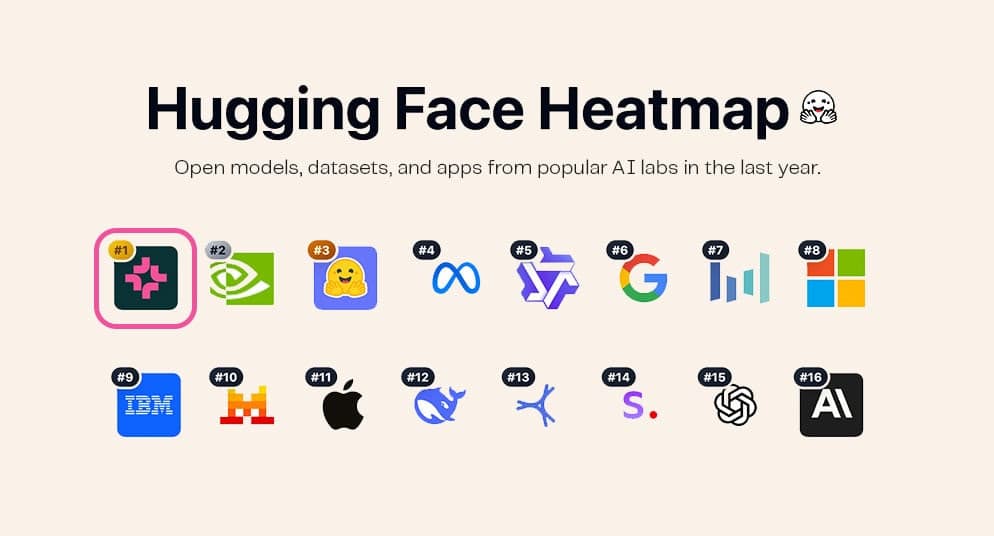
We ended the year as the #1 open model builder on the Hugging Face Heatmap:
And Artificial Analysis named our flagship Olmo 3 32B Think model the top in the industry on their new Openness Index.
Here's a look back at all we built together.
The Olmo family comes of age
Our flagship language model family reached new heights. In March, we released Olmo 2 32B – the first fully open model to outperform GPT-3.5 Turbo and GPT-4o mini – reaching this milestone at just one-third the training cost of comparable models.
Complementing Olmo 2 32B, we released Tülu 3 405B—the first application of fully open post-training recipes at the largest scale. Training at 405B parameters on 256 GPUs, Tülu 3 405B achieves competitive or superior performance to DeepSeek V3 and GPT-4o while surpassing prior open-weight models like Llama 3.1 405B Instruct.
Then in November, we unveiled Olmo 3, delivering what we call the complete model flow: an entirely transparent pipeline from data to deployment. Olmo 3 introduced our first fully open 32B reasoning model, Olmo 3-Think, which stands as the strongest fully open reasoning model available—competitive with Qwen 3 and DeepSeek R1 Distill. The family spans 7B and 32B sizes with variants for different use cases, all trained on Dolma 3, our 5.9-trillion-token dataset that we've released in full.
Molmo 2: Multimodal for video
Building on last year's Molmo release, Molmo 2 is a state-of-the-art video language model family with fully open weights, training data, and code. The models handle single images, multi-image inputs, and video, but what sets them apart is grounding. Molmo 2 can pinpoint exactly where and when events occur in space and time, enabling applications from robotics to traffic monitoring to assistive technology.
We built nine novel datasets specifically targeting skills underrepresented in existing open-source data: dense video captioning with unprecedented detail, long-form QA for multi-image and video inputs, and critical datasets for open-vocabulary video pointing and tracking. Importantly, none of it was distilled from proprietary models.
Molmo 2 variants at 4B, 7B, and 8B parameters achieve state-of-the-art results on benchmarks like MVBench and MotionQA, and human evaluators rank them competitive with or superior to top closed-source alternatives.
From vision to action: MolmoAct
Understanding images and video is one thing—acting on that understanding is another. With MolmoAct, we introduced the first Action Reasoning Model (ARM), a new class of models that can reason about actions in 3D space.
Built on Molmo, MolmoAct bridges language and physical action by grounding scene semantics through depth-aware perception tokens. Given an instruction, the model sketches out a visual reasoning trace via waypoints in image space and converts that plan into low-level action commands for robotic hardware.
With minimal fine-tuning, MolmoAct adapts to different embodiments – from robotic humanoids to gripper arms – more effectively than even strong baselines like Physical Intelligence's π0 and OpenVLA.
Asta: An ecosystem for scientific AI
In August, we launched Asta, an integrated open ecosystem for scientific AI agents. Asta brings together three components: trustworthy agentic assistants for researchers, AstaBench (a comprehensive eval framework for scientific agents), and shared resources for building models that can help aid in scientific research tasks.
Within the Asta ecosystem, Asta DataVoyager became generally available in December. This data analysis agent lets researchers upload datasets, ask questions in plain language, and receive reproducible outputs with statistical rigor—all while keeping data private and never using it for training. More than 70 universities, institutes, and companies have already adopted it, and a federated instance now powers research for the Cancer AI Alliance (CAIA).
Understanding Earth from space—and sea
OlmoEarth Platform, launched in November, represents the first open end-to-end solution for transforming satellite and sensor data into real-time Earth insights. Our OlmoEarth foundation models – trained on millions of observations totaling roughly 10TB – come in multiple sizes and power applications from crop mapping in Kenya to Amazon deforestation detection to wildfire risk modeling with NASA JPL.
We also released SamudrACE, a breakthrough climate emulator developed with NYU, Princeton, M2LInES, and NOAA. For the first time, SamudrACE couples 3D models of both the ocean and atmosphere, enabling accurate simulation of critical phenomena like El Niño. The system can simulate 1,500 years of global climate in a single day on a single H100 GPU—enabling the kind of large-scale climate projections that previously required weeks on supercomputers.
Meanwhile, Atlantes, our AI-powered GPS model suite for maritime intelligence, now processes over 5 billion GPS messages daily on just five GPUs. The system forms the backbone of Skylight, which monitors more than 10 million square kilometers of ocean daily to combat illegal fishing.
New tools for transparency and research
OlmoTrace arrived in April—a one-of-a-kind feature in the Ai2 Playground that traces model outputs back to their source in our multi-trillion-token training data in real time. When you ask Olmo a question, OlmoTrace can show you exactly which documents in the training corpus contain matching text, enabling a new level of transparency and trust.
We also shipped olmOCR 2, achieving state-of-the-art performance for real-world document OCR. The model scores 82.4 on olmOCR-Bench, outperforming both specialized tools like Marker and MinerU as well as general-purpose vision-language models.
Partnerships for open science
This year brought major collaborations. In August, NSF and NVIDIA jointly awarded $152 million for the Open Multimodal AI Infrastructure to Accelerate Science (OMAI) project, led by Ai2's Dr. Noah A. Smith. In April, we partnered with Google Cloud to bring Olmo, Tülu, and Molmo to Vertex AI Model Garden. And through the CAIA, Ai2 and Google Cloud each invested $10 million to advance AI-powered cancer research.
What it all means
Every release this year followed the same principle: openness first. We made not only weights but data, training code, eval frameworks, and entire platforms openly available for researchers and developers to study and build upon. Fast Company recognized this commitment by naming Ai2 among the Most Innovative Companies of 2025.
As we head into 2026, the foundation is set: language models that think, vision models that ground understanding in space and time, agents that accelerate scientific discovery, ARM models that reason in three dimensions, and Earth observation systems that protect our planet—all of it open, all of it built to advance what's possible for everyone.
Thanks for joining us on the journey.
—The Ai2 team