Ai2 Newsletter
November 2026
Top story - Ai2 and Google advance climate modeling & introducing ToyBlocks for robot learning
In this issue of the Ai2 newsletter, we’re sharing our new climate modeling initiative, supported by funding from Google.org and technical expertise from Google Research, to make long-term climate projections faster and more reliable. We’re also introducing ToyBlocks, an open simulation framework for studying how robots learn, where they struggle, and ways they could improve.
Collaborating with Google on climate modeling
On Wednesday, we announced an ambitious climate modeling project supported by multimillion-dollar, three-year funding from Google.org and technical support from Google Research. The funding will expand our Climate Modeling team as we develop NeuralGCM+, an open-source effort to make long-term climate projections faster and more reliable.
The project builds on Google Research’s NeuralGCM, which combines physical equations for atmospheric motion with AI representations of smaller-scale processes such as cloud formation and rainfall. We will extend it to simulate the atmosphere and ocean together, including how oceans absorb and redistribute heat. Those interactions are essential to understanding climate over decades.
Google Research will continue developing NeuralGCM for forecasts over weeks to months. We’re bringing our climate-modeling expertise to questions spanning years to decades—for example, how warming and changes in the Pacific Ocean could affect rainfall and prolonged dry periods in the southwestern United States through mid-century.
Faster simulations could let scientists explore more possible futures and investigate uncertainties in regional climate. Making reliable projections of climates outside a model’s training experience remains a research challenge. Our work will include adding established physics and testing the model against conventional simulations of warmer conditions.
Google.org’s support will help us extend this work to academic researchers and climate-modeling centers. Building on NeuralGCM’s existing open-source code and available weights, we plan to release models and modeling frameworks with documented workflows for training, adaptation, and code contributions. We will also improve performance on widely used GPUs.
Our goal is a shared research platform that scientists can build on together and use to inform decisions communities face, from water planning to climate adaptation.
ToyBlocks: A foundation world for robotics
Robots are learning to fold laundry, sort parts, and handle unfamiliar objects, but those demonstrations don’t always reveal what a model has learned or why it fails. To advance the science of robot learning, researchers need controlled settings where they can systematically vary training conditions and trace the causes of success and failure.
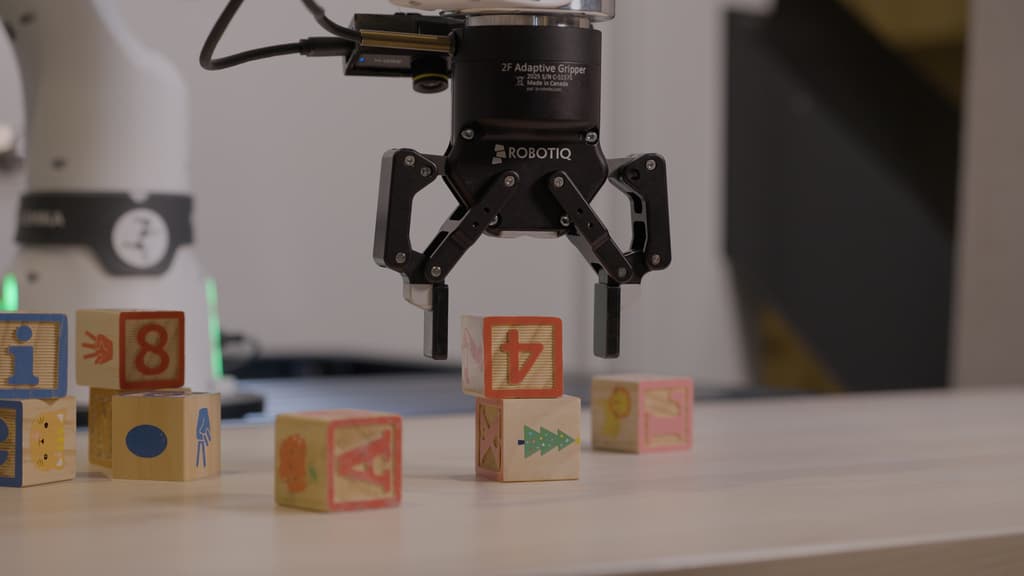
We’re introducing ToyBlocks, our first open simulation framework designed as a foundation world for robot learning. Built around a robotic arm and lettered tabletop blocks, ToyBlocks combines reinforcement learning skill policies with automated task and motion planning to generate manipulation demonstrations without teleoperation.
The framework connects data generation, policy training, and evaluation in a single setting, so researchers can study spatial reasoning, multi-step planning, and generalization as tasks and geometry change. We’re releasing simulation assets, procedural task and demonstration generators, automatically generated demonstrations, training code, and evaluation code, so other teams can build their own training mixtures and investigate failure modes.


StateBench
We introduced StateBench to test how well language models track changing information across long inputs, such as variables being reassigned in code. Its four difficulty levels range from recalling a value that never changes to following chains of updates in which one variable copies another's current value.
Four frontier models handled the simpler levels well, but their accuracy fell sharply on the two harder levels as inputs grew, dropping to 13% or lower on the longest problems at the hardest level. The release includes code for generating StateBench problems and the benchmark dataset, so researchers can test where new architectures break down as context grows.

HiRO-ACEv2
HiRO-ACEv2 pairs a 100 km atmospheric emulator with a downscaling model that produces 3 km rain, wind, and pressure data. The full system generates global high-resolution climate data at about 1/300th the cost of X-SHiELD, its reference model.

OlmoEarth v1.3
OlmoEarth v1.3 turns satellite imagery into reusable numerical features for mapping and analysis. We released the model alongside precomputed embeddings for every 10-meter square of the world's land, across multiple years. Alongside v1.3, we launched the OlmoEarth Embeddings Explorer, a browser-based tool for comparing years, finding similar places, and building maps from a few labeled examples.
New to embeddings? Our interactive story walks you through what they are. A volcanic eruption, mangroves mapped in a few taps, a forest cleared in a week, and more. Explore ways that embeddings could help protect our planet.

FairStress
FairStress tests demographic fairness beyond a model’s final choice, examining how readily it changes a decision under persuasion and how it explains that decision. Its 300 scenarios span 29 domains, with demographic and persuasion variations expanding them into more than 13 million test cases.

Highlights from COLM
Thank you to everyone who joined us at COLM in San Francisco and at our Open Science, Open House gathering. Our blog recap includes a conversation with Noah A. Smith about the next iteration of Olmo and our work on agentic models, along with highlights from the week.

Bolmo in Nature
During the conference, the research behind Bolmo, our family of fully open byte-level language models, was published in Nature. Most language models first split text into chunks from a fixed vocabulary; Bolmo works directly with the bytes that represent characters. We also released additional checkpoints so researchers can experiment with the approach.